
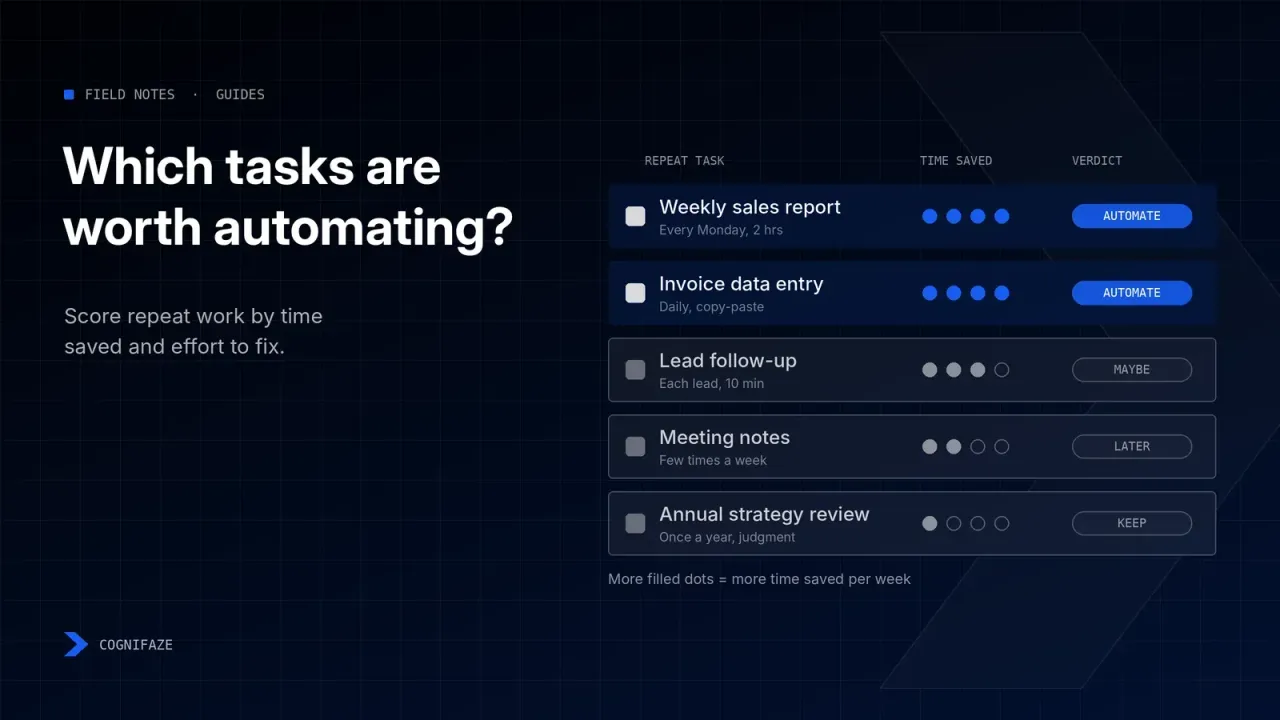
Almost every business has work that repeats. The same details typed into two tools. The same question answered by message ten times a day. The same report built by hand every week. Not all of it is worth automating, and starting with the wrong task is the most common way automation goes wrong. Here is a simple way to choose.
Step 1: Write down the repeat work for one week
For one week, ask your team to note every task they do more than once. Keep the note short: what the task is, who does it, and roughly how often. Do not try to judge anything yet. The aim is a list, because most people are surprised by how much repeat work they find once they start writing it down.
Step 2: Score each task on four questions
Give each task a score of 1 to 3 on these questions, where 3 is the strongest yes.
Does it happen often? A task that happens daily is a better candidate than one that happens twice a year.
Does it follow clear rules? If you could explain the steps to a new colleague in a few lines, a system can probably follow them too.
Does it take real time? Short tasks add up, but a task that eats a lot of someone’s day is usually the better place to start.
Is a small mistake easy to fix? Tasks where an error is cheap to correct are safer to start with than tasks where one error is costly.
Step 3: Look at the top of the list
Add up the scores. The tasks with the highest totals are your first candidates. Typical examples are copying details between tools, sending first replies to enquiries, booking and reminding, and building routine reports. You do not need to automate them all. One or two is enough to begin with.
What to leave for later
Be careful with tasks that depend on judgement, on a relationship, or on unusual cases. A person should still handle those, or at least approve the result. Also leave out tasks your team has not agreed on how to do, because automation makes an unclear process faster, not clearer.
Step 4: Start with one and watch it
Pick one task, automate it, and look at how it runs for a few weeks. Check whether the work gets done correctly and whether your team trusts it. Then pick the next one. A small system that works is worth more than a large one that nobody uses.
Want help with the list?
Our free automation audit asks six short questions about your repeat work and points to where we would look first. You can try it on our website, and if you want a person to review your results, you can send them to us.